

Every enterprise AI initiative eventually collides with the same wall: the model is smart, but it does not know your business. A general-purpose large language model can write a marketing email, summarize a contract, or draft a support reply. But it cannot tell you which of your customers churned last quarter, what your procurement policy actually says, or how your pricing changed across regions — unless you give it access to that knowledge. This is the core challenge of enterprise AI in 2026, and it is why the most successful organizations are no longer asking "which model should we use" but "how do we build the knowledge layer that makes any model useful to us."
That knowledge layer is the connective tissue between your data and your AI systems. It is the retrieval-augmented generation (RAG) pipeline, the vector index, the governance framework, and the access controls that let an AI agent answer questions, take actions, and make decisions with your enterprise context — not generic internet context. In this post, we break down what an enterprise knowledge layer is, why it has become the deciding factor in AI ROI, and how to build one that is accurate, secure, and ready for the agentic systems that are reshaping enterprise software.
Why the Knowledge Layer Is the New Competitive Moat
For years, the assumption was that better models would automatically produce better business outcomes. That assumption is fading. As models have commoditized, the differentiator has shifted to the data and context each organization can bring to bear. Two companies can use the same foundation model and get wildly different results — one produces a support agent that resolves 80 percent of tickets autonomously, the other produces one that hallucinates policy and frustrates customers. The difference is almost never the model. It is the quality, completeness, and accessibility of the knowledge the model is given.
Industry research points in the same direction. McKinsey's 2026 technology trends work reports that organizations embedding AI into their core processes see productivity gains of 35 to 45 percent while cutting time-to-market by roughly 30 percent. But those gains are concentrated in companies that have invested in their data foundation first. A Forrester study of 500 enterprise development teams found that AI-assisted code generation cut routine coding time by an average of 42 percent — yet the teams that benefited most were those with clean, well-governed codebases and documentation that AI could actually retrieve. The pattern is consistent: AI amplifies whatever knowledge you already have. Garbage in, garbage out has never been more literal.
This is why the knowledge layer is a moat. Your proprietary data — your customer histories, your operational telemetry, your institutional expertise, your hard-won lessons — is something no competitor and no public model can replicate. When you wire that data into your AI systems, you create answers and actions that are genuinely unique to your business. That is not a feature; it is a defensible advantage that compounds over time.
What an Enterprise Knowledge Layer Actually Contains
An enterprise knowledge layer is not a single tool. It is an architecture made of several coordinated components, each responsible for getting the right knowledge to the right system at the right time.
1. The Source Systems
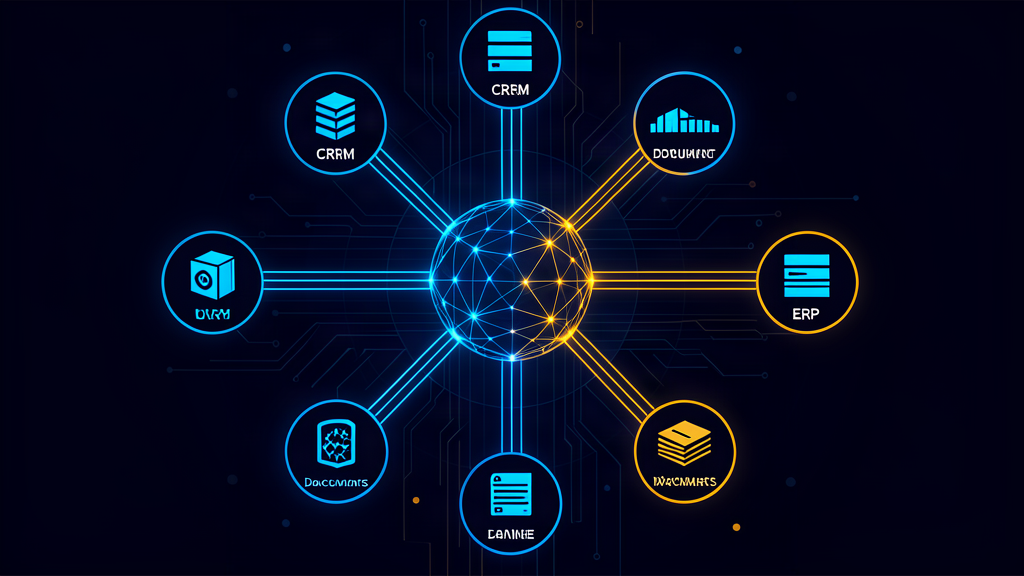
Your knowledge starts in the systems you already run: the CRM, the ERP, the ticketing platform, the document management system, the data warehouse, the code repository, the product catalog. The knowledge layer does not replace these systems — it connects to them, ingests their content, and keeps that content fresh. The first step in any knowledge-layer project is an honest inventory of where your institutional knowledge actually lives and who owns it.
2. The Ingestion and Processing Pipeline
Raw data is not knowledge. Documents need to be parsed, cleaned, chunked, and enriched. Unstructured content — PDFs, emails, meeting notes, support transcripts — needs to be converted into a form that retrieval can use. This pipeline handles deduplication, format normalization, metadata extraction, and the chunking strategy that determines how well your retrieval will perform. A poorly chunked document produces fragmented, out-of-context answers no matter how good your model is.
3. The Vector Index and Retrieval Layer
This is the heart of RAG. Content is embedded into high-dimensional vectors that capture semantic meaning, then stored in a vector index that supports fast similarity search. When a user or agent asks a question, the retrieval layer finds the most relevant chunks and feeds them to the model as context. The quality of this layer — the embedding model, the index structure, the hybrid search that combines semantic and keyword matching — determines whether your AI answers are grounded in your data or drifting into hallucination.
4. The Governance and Access Layer
Knowledge is only valuable if it is also safe. The governance layer controls who and what can retrieve which information. It enforces role-based access, redacts sensitive content, tracks provenance, and ensures compliance with regulations like PIPEDA, GDPR, and industry-specific standards. In an agentic system, this layer is non-negotiable: an AI agent that can retrieve anything can also leak anything. Access control is what turns a powerful tool into a trustworthy one.
5. The Evaluation and Feedback Loop
A knowledge layer is never finished. It needs continuous evaluation — measuring retrieval quality, answer accuracy, and user satisfaction — and a feedback loop that feeds corrections back into the system. When an answer is wrong, the system should learn why and improve. This operational discipline is what separates a demo from a production system.
RAG: The Bridge Between Models and Your Data
Retrieval-augmented generation is the technique that makes the knowledge layer practical. Instead of relying on a model's static training data, RAG retrieves relevant information from your knowledge base at query time and injects it into the model's context. The model then generates an answer grounded in that retrieved evidence, with citations you can trace back to the source.
RAG solves three problems that plague enterprise AI. First, it keeps answers current — your knowledge layer reflects today's data, not the model's training cutoff. Second, it grounds answers in your proprietary context, dramatically reducing hallucination. Third, it makes AI auditable: because every answer is built from retrievable sources, you can verify, correct, and defend what the system says. For regulated industries, that auditability is not a nice-to-have; it is a requirement.
The most advanced deployments are moving beyond simple RAG toward agentic retrieval. Instead of a single query-and-answer pass, an agent can plan a multi-step retrieval, call multiple tools, re-rank results, and iterate until it has the information it needs. This is where the knowledge layer becomes truly powerful — and where the demands on data quality and access control become most acute.
From RAG to Agentic Systems: Why the Foundation Matters More Than Ever
By 2028, analysts expect a third of enterprise software to include agentic AI — systems that do not just answer questions but plan, decide, and act. Gartner-style projections suggest AI agents will influence or handle a growing share of business decision-making within a few years. These agents will not be bolted onto your stack; they will be woven into your workflows, your customer journeys, and your operations.
An agent is only as good as the knowledge and tools it can access. An agent that can retrieve your full customer history, your current inventory, your pricing rules, and your support policies can resolve issues, recommend products, and take actions that feel genuinely intelligent. An agent that can only access a fraction of that knowledge will stall, guess, or fail. The knowledge layer is the difference between an agent that augments your team and an agent that frustrates your customers.
This is why the order of operations matters. Organizations that try to deploy agents before building their knowledge layer are building on sand. The agent will hallucinate, leak, or underperform, and the initiative will be written off as a failure. Organizations that invest in the knowledge layer first — the data, the retrieval, the governance — find that agents become dramatically easier to deploy and far more valuable once they arrive.
Security and Governance: The Non-Negotiables
An enterprise knowledge layer concentrates your most sensitive information in one place, which makes security and governance central to the design — not an afterthought. Every component must be built with access control in mind.
Start with least-privilege access. A user or agent should only be able to retrieve the information their role legitimately requires. This means embedding access controls into the retrieval layer itself, not just the application layer — a support agent should not be able to retrieve payroll data, and a marketing agent should not be able to pull customer PII it does not need. Role-based and attribute-based access control must be enforced at query time, on every retrieval.
Data protection is equally critical. Sensitive fields should be redacted or masked before content enters the index. Encryption should protect data both at rest and in transit. And you need a clear data-retention policy that governs how long indexed content lives and when it is purged. In regulated environments, you also need audit trails that record what was retrieved, by whom, and for what purpose — so that every AI decision can be traced and defended.
Finally, treat the knowledge layer as part of your broader security posture. It should sit behind your existing network and identity controls, be monitored for anomalous access patterns, and be included in your incident-response planning. A knowledge layer that is secure by design is an asset; one that is bolted on is a liability.
Measuring Success: Metrics That Matter
Building a knowledge layer is an investment, and like any investment it needs to be measured. The metrics fall into three buckets.
Retrieval quality is the foundation. Measure retrieval precision and recall — how often the system finds the right information, and how often it misses. Track the percentage of answers that are grounded in retrieved sources versus those that drift into hallucination. These are the leading indicators that everything downstream will work.
Business outcomes are the point. For a support use case, measure resolution rate, average handling time, and customer satisfaction. For a sales use case, measure conversion and deal velocity. For an internal knowledge use case, measure the time employees save finding information. The knowledge layer should move these numbers, and if it does not, the retrieval or the use case needs attention.
Operational health keeps it running. Track index freshness, pipeline failure rates, retrieval latency, and the cost per query. A knowledge layer that is slow, stale, or expensive will quietly erode trust and adoption. Continuous monitoring and a feedback loop that feeds corrections back into the system are what keep the layer accurate over time.
Getting Started: A Practical Roadmap
You do not need to boil the ocean. A pragmatic knowledge-layer initiative follows a clear sequence.
- Pick one high-value use case. Choose a domain where the knowledge is well-defined and the business value is clear — a support assistant, a sales enablement tool, or an internal search for a specific function. Do not try to solve every problem at once.
- Inventory and clean your data. Identify the source systems, assess data quality, and fix the worst gaps. Clean, well-structured data is the single biggest predictor of success.
- Build a minimal retrieval pipeline. Stand up ingestion, chunking, embedding, and a vector index for your chosen domain. Get a working end-to-end flow before optimizing.
- Enforce access control from day one. Build role-based retrieval into the first version, not the tenth. Retrofitting security is far more expensive than designing it in.
- Measure, evaluate, and iterate. Establish your retrieval and business metrics, then run a feedback loop that continuously improves accuracy and coverage.
- Expand deliberately. Once the first use case is producing measurable value, extend the layer to adjacent domains and, eventually, to agentic workflows.
The Bottom Line
The models are no longer the bottleneck. In 2026, the organizations that win with AI are the ones that have built the knowledge layer their AI systems depend on — the data foundation, the retrieval pipeline, and the governance that makes it all safe. This is not a technology project you can delegate to a single team and forget. It is a strategic capability that touches every part of the enterprise, and it compounds: every piece of knowledge you connect makes your AI more accurate, more useful, and more defensible.
At Tech Hub Services, we help enterprises design and build the knowledge layers, RAG pipelines, and agentic systems that turn raw data into a competitive advantage. Whether you are starting your first AI initiative or scaling an existing one, the foundation you build today determines what your AI can do tomorrow. Contact Tech Hub Services at info@techhubservices.com or +1-416-477-6087 to start building yours.