
Enterprise AI is entering its hardest phase. The era of the impressive demo is over; the era of the accountable, production-grade AI agent has arrived. Across 2026, executives are discovering that the gap between a pilot that dazzles and a system that reliably delivers business value in production is wide — and that most organizations are unprepared to cross it. The numbers are sobering. Gartner projects that more than 40% of agentic AI projects will be cancelled by the end of 2027, undone by escalating costs, unclear business value, and inadequate risk controls. MIT research found that only 5% of enterprise AI pilots from 2025 delivered measurable P&L impact in production. Yet at the same time, Gartner predicts that by the end of 2026, AI agents will be embedded in roughly 40% of enterprise applications — a near-tenfold increase in a single year.
This is not a contradiction. It is the definition of a market in transition. The organizations that succeed with agentic AI are not the ones with the flashiest pilots. They are the ones that treat agent deployment as a governance and operating-model problem first, and a technology problem second. This guide explains why agentic projects fail in production, what separates the survivors from the casualties, and how to build an enterprise AI program that delivers durable ROI rather than a portfolio of expensive demos.
The Promise Versus the Production Reality
The business case for agentic AI is genuinely compelling. AI agents — software that does not merely answer questions but takes action, orchestrating workflows, querying systems, and making decisions within defined guardrails — promise to compress weeks of manual work into minutes. They can triage support tickets, reconcile invoices, monitor supply chains, draft and review code, and coordinate across departments without constant human intervention.
The promise, however, is gated by a brutal reality: pilots are optimized for success. They run on curated data, with engaged users and dedicated support teams. Production is where the conditions change. Data is messy and scattered across legacy systems. Users are busy and skeptical. Edge cases multiply. Integration complexity compounds when agents must talk to old ERP platforms, CRMs, and databases that were never designed for autonomous access.
The result is a well-documented pattern: a pilot that performs beautifully in the lab collapses, or stalls, when it meets the real enterprise. According to one widely cited analysis of enterprise agent programs, only 50–60% of projected savings are typically realized even at full production rollout — and the remainder depends entirely on process optimization and change management, not technology. The technology works. The operating model does not.
Why Agentic Projects Fail in Production
Understanding the failure modes is the first step toward avoiding them. Across the enterprise landscape, four root causes account for the majority of stalled and cancelled agentic initiatives:
- Agent sprawl. Teams deploy agents in silos, with no central registry, no shared data-access policy, and no consistent way to observe what each agent is doing. Within months, the organization has dozens of ungoverned agents, each behaving differently and none held accountable. Sprawl is the hidden governance crisis of 2026.
- Unclear business value. Agents are launched because they are technically impressive rather than because they solve a quantified business problem. Without a defined baseline and a measurable target outcome, the project has no way to demonstrate ROI — and becomes an easy target for the next budget cycle.
- Inadequate risk controls. Agents act. That is the point. But an agent that acts without guardrails, audit trails, and human-in-the-loop escalation is a liability. Regulated enterprises in particular face consequences when autonomous systems touch sensitive data or take irreversible actions.
- Change management treated as an afterthought. A tool deployed is not a tool adopted. Agents that sit alongside an existing process remain optional; agents embedded in a redesigned workflow become integral. The difference is organizational work, not technical work.
Each of these failure modes is preventable. But prevention requires a deliberate shift in how enterprises approach AI — away from "build a model" and toward "operate an accountable system."
Design the Operating Model Before You Deploy an Agent
The most important insight of the agentic era is that a sound enterprise AI strategy does not start with the model. It starts with the deployment architecture and the operational controls that will govern the agent at scale. Governance, data quality, and agent orchestration must be treated as integrated systems rather than siloed concerns — this integration is what determines whether an AI program becomes a competitive advantage or a collection of impressive demos.
Formal frameworks now exist to anchor this discipline. The ISO/IEC 42001 standard provides an AI management system framework that mandates continuous monitoring and lifecycle responsibility rather than point-in-time compliance. The NIST AI Risk Management Framework offers a complementary structure for identifying, assessing, and managing AI-related risks across the entire lifecycle. Enterprises that ground their agent programs in these frameworks do not merely check compliance boxes; they build the traceability and accountability infrastructure that production agents require.
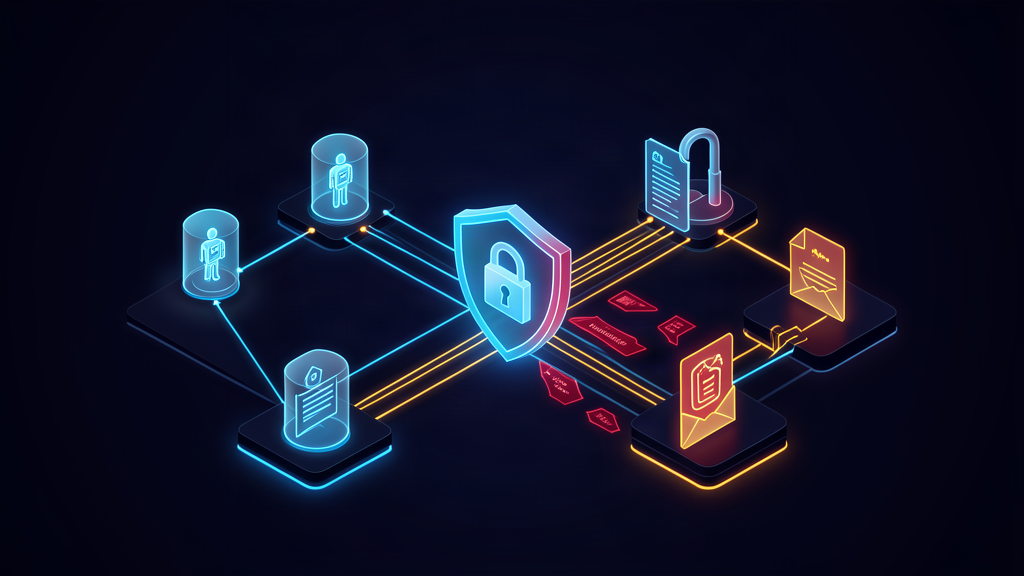
Digital provenance matters as much as access control. In an autonomous system, you must be able to reconstruct how and why a particular outcome occurred — which agent acted, on what data, following what instruction, with what result. Traceability is not an optional luxury. It is the foundation of trust in any system that acts without waiting for a human to click "yes."
Governance Designed In: Three Questions Before Any Agent Goes Live
Experienced practitioners converge on a remarkably simple starting point: before any agent is permitted to act autonomously, leadership must answer three questions. Getting these right in advance prevents the vast majority of production incidents.
- Who is accountable, and what happens on failure? When the agent acts, who owns the outcome? What happens when it makes a mistake? A named accountable owner and a defined incident-response path turn an autonomous system into a governed one.
- What data can it access, and what is explicitly out of scope? Agents inherit the permissions of the systems they touch. Defining access boundaries in advance — what the agent may read, write, and act upon, and what is strictly off-limits — is essential in regulated environments and a safeguard everywhere.
- How will performance degradation be detected, and with what correction process? Agents drift. Models change, data changes, business rules change. A production agent needs continuous monitoring that detects when its outputs degrade, plus a defined process for intervention, retraining, or rollback.
These three questions are the governance backbone of a production-grade agent. Organizations that answer them deliberately before deployment — rather than reactively after an incident — build systems that earn the trust required for scale.
Embed the Agent — Don't Just Buy the Tool
As one leading technology executive put it: "Buying a tool isn't the same as embedding it. An agent alongside the process stays optional, but one embedded in the workflow becomes integral to it." This distinction is the difference between an AI investment that languishes and one that compounds.
Embedding means redesigning the workflow around the agent's strengths and the human's judgment. It means defining precisely which steps the agent owns end-to-end, where it hands off to a human for review or escalation, and how the two collaborate. It means investing in adoption: training users, documenting the new process, and measuring whether the agent is actually being used — not just whether it exists.
Adoption is frequently the dominant ROI variable. A pilot with engaged, motivated users will outperform a technically superior system that nobody trusts. The organizations that succeed budget for change management as deliberately as they budget for infrastructure, and they treat user adoption rate as a first-class success metric from the outset.
Measuring What Actually Matters: ROI Beyond Cost Reduction
ROI for agentic AI is notoriously difficult to measure, and the temptation to chase a single "cost savings" number is strong. But the value of an autonomous system is rarely captured by headcount reduction alone. Enterprises that measure agent value effectively track a broader, more honest set of metrics:
- Cycle time. How much faster does a business process complete from start to finish with the agent in the loop?
- Throughput and capacity. How much more work can the organization absorb without adding headcount?
- Quality and consistency. Are error rates, rework, and exceptions falling?
- Risk and compliance outcomes. Is the agent operating within guardrails, with complete audit trails?
- Employee experience. Is the agent removing drudgery and freeing people for higher-value work?
The honest, realistic framing is important: at full production rollout, only about half of projected savings are typically realized, with the remainder gated on process optimization and change management. A realistic forecast that accounts for this does not disappoint leadership — it builds the credibility that sustains a program through the hard middle period.
A Phased Roadmap for the Agentic Enterprise
Treating agentic AI as a design-led discipline, rather than a technology implementation, produces a clear and repeatable path to value. The most effective enterprises move through four phases, each building on the last:
- Phase 1: Foundation and assessment. Inventory your data, systems, and processes. Identify which workflows are genuinely suited to autonomous execution and which are not. Establish the governance baseline and the three accountability answers before building anything.
- Phase 2: Targeted implementation. Deploy a small number of agents in high-value, well-bounded use cases with clear metrics. Prove value fast, in the first 90 days, with risk-reduction and near-term impact as the primary goals.
- Phase 3: Scaling and operationalization. Standardize governance, monitoring, and change management across multiple agents. Embed them into workflows. Measure adoption relentlessly. This is where most projects succeed or stall.
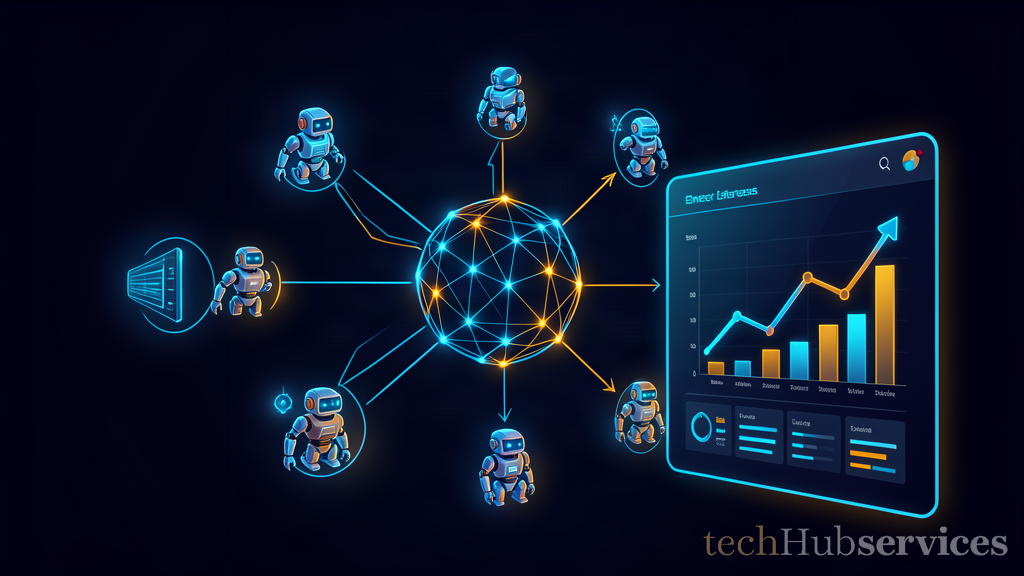
- Phase 4: Strategic transformation. Connect agents across functions into coordinated multi-agent ecosystems, orchestrated centrally, with a unified knowledge layer and consistent controls. This is the point at which agentic AI becomes a genuine competitive advantage.
This roadmap has a built-in bias toward proof over promise. Initiatives without short-term metrics or realistic ROI timelines should be deferred. Momentum and trust are built through visible, quantifiable wins — not sweeping transformation narratives.
New Roles and the Human Layer
The agentic enterprise is not a workforce-free enterprise. On the contrary, it creates new and essential roles for people. Positions such as AI Operations Manager, Workflow Orchestrator, and Agent Supervisor are becoming central to transformation programs. These professionals oversee agent ecosystems, monitor performance, interpret insights for strategic decisions, and handle the edge cases that autonomous systems still cannot.
For the broader workforce, the shift is toward upskilling rather than replacement. Employees transition from repetitive, manual tasks into higher-value roles in data strategy, process innovation, and AI governance. The successful agentic enterprise pairs autonomous systems with skilled human oversight — machines handling the volume, people providing the judgment, accountability, and context.
Building the Agentic Enterprise That Survives Production
The message of 2026 is clear: the competitive advantage in AI no longer belongs to the organizations with the most ambitious pilots. It belongs to the ones that can move agents from the lab to the production floor without losing control, value, or trust. That requires treating governance, data quality, and change management as first-class engineering disciplines — and answering the hard accountability questions before an agent ever takes an autonomous action.
At Tech Hub Services, we help enterprises design and build the operating models that make AI deliver — not just demos, but durable, measurable business outcomes. From governance frameworks and data architecture to embedded workflow automation and production-grade agent orchestration, we turn AI ambition into accountable, scalable systems. Whether you are launching your first production agent or scaling an existing program, the right foundation determines whether your investment compounds or collapses.
Contact Tech Hub Services today at info@techhubservices.com or +1-416-477-6087 to build an agentic AI strategy that actually delivers in production. The era of the pilot is over. The era of the accountable, value-producing AI enterprise is here.