
Traffic arrived before the architecture did
Adobe's retail index is the closest thing the industry has to a neutral read on AI shopping, and the first-quarter 2026 numbers are not subtle. Traffic from AI sources to US retail sites grew 393% year over year between January and March. In March, AI-referred visitors converted 42% better than visitors from paid search, email, or any other channel Adobe measures. In March 2025, the same cohort converted 38% worse than everyone else.
That reversal is not a traffic story. AI-referred shoppers arrive after they have already compared options in a chat window, which explains why their sessions last 48% longer and touch 13% more pages than non-AI sessions. Adobe's companion survey found 39% of consumers have used AI for shopping and 66% trust the results enough to act on them. By July 2026 the conversion gap had widened to 60%, with revenue per visit running 53% above non-AI traffic.
Then the protocols moved. OpenAI launched Instant Checkout in September 2025 and spent March 2026 walking it back. Checkout now happens on the merchant's own site through an in-app browser, with the assistant handling discovery and comparison. Google went the other way and shipped the Universal Commerce Protocol in January 2026, adding cart support and catalog access in March, with UCP checkout still in early access for eligible US merchants.
Two of the largest platforms changed their minds about checkout inside six months. Any roadmap built around one protocol's specifics will get rebuilt. The catalog data underneath it will not. That distinction decides where the budget goes.
Four layers every shopping agent has to cross
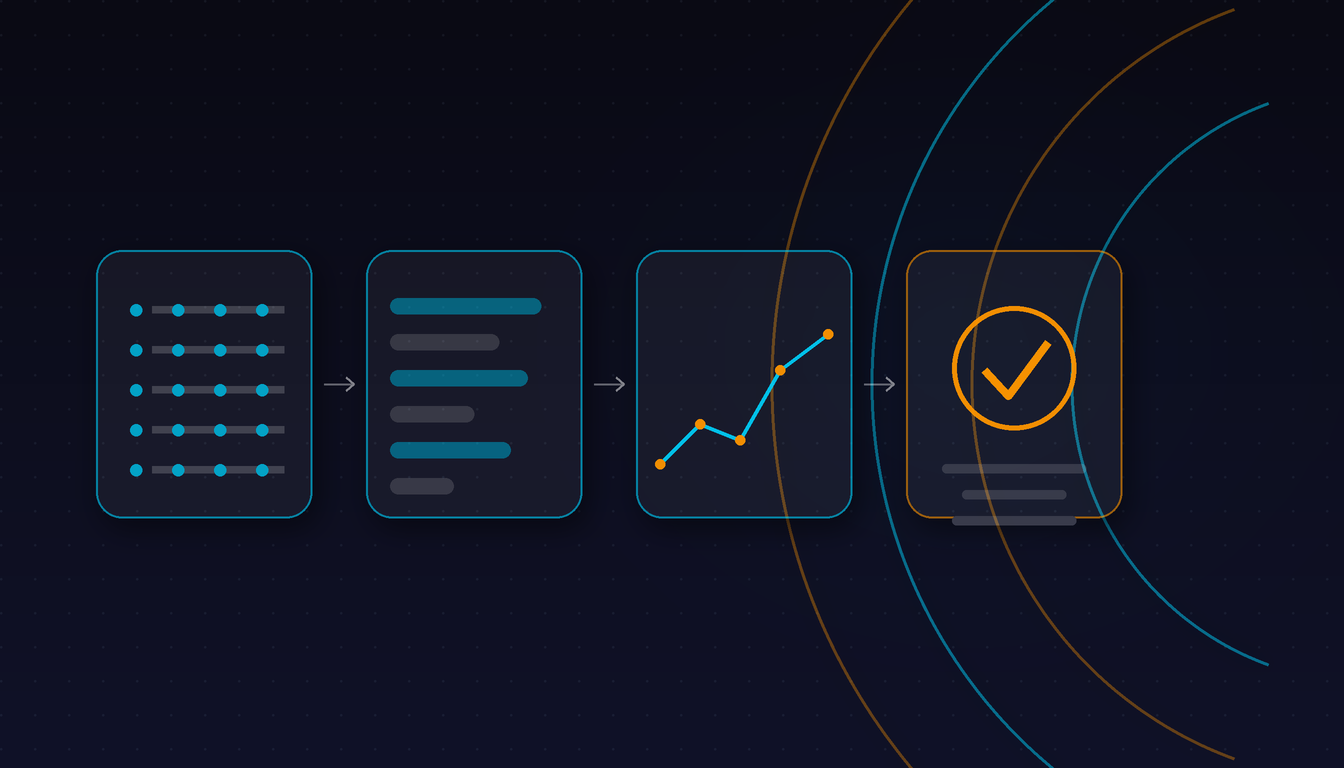
Strip away the protocol branding and an agent doing commerce has four problems to solve: find the product, verify the terms, complete the transaction, and stay inside the retailer's abuse controls. Each layer fails differently, and the costs are not equal. A bad catalog wastes a recommendation. A bad checkout loses the order. A bad perimeter rule hides the store from the channel entirely.
Layer one: product data a model can read in full
Adobe scores pages with a tool that estimates how much of the content a language model can actually ingest. Across US retail, homepages average 75%. Product pages average 66%, which means roughly a third of the average product page never reaches the model that is supposed to recommend it. Category pages sit at 74%.
The usual cause is not exotic. Specs live in a tab that renders on click. Size charts load inside an iframe. Variant names exist only as swatch colours. Reviews arrive through a third-party widget that injects after paint. A shopper's browser fills in the gaps. A model gets a page that says "select options" and little else.
The fix is unglamorous engineering. Server-render the specification table. Put JSON-LD on every product page carrying Product, Offer, gtin13, and AggregateRating where review data is real. Name variants explicitly ("Matte black, 42mm, GPS and Cellular") rather than relying on a colour dot. Keep one canonical URL per variant. When a manufacturer supplies a two-line description, write the missing two hundred words, because that text is now the difference between being quoted in an answer and being passed over.
Layer two: price and availability that tell the truth
An agent that quotes a price has made a promise on the retailer's behalf. Stale feeds break that promise faster than an outage, because the failure lands in front of a customer who was ready to buy.
Three checks catch most of it. Diff the feed against the live product page for fifty high-traffic SKUs, three times a day, and alert on any mismatch larger than a few cents. Confirm that inventory decrements across channels rather than per channel, so a warehouse sale does not oversell the web store. Publish shipping cost and delivery window as structured fields instead of prose buried in a help article, because those are the fields an agent compares when two merchants quote the same product.
Return policy deserves the same treatment. "30 days, unopened, buyer pays return shipping" belongs in a machine-readable block on the product page and in the feed, not only in a PDF. Agents increasingly filter candidates on return terms before they ever surface a recommendation, and a store with unreadable terms loses comparisons it never knew it was in.
Layer three: a checkout an agent can complete without a human
This is the layer where 2026 has been least stable, so the right move is deliberately conservative. Build to whichever protocol has live traffic behind it, keep the integration behind an adapter, and treat the whole thing as replaceable.
Concretely: allow guest checkout without account creation. Accept the payment tokens the platforms issue rather than demanding card entry inside a browser session. Make every order endpoint idempotent so a retried request does not create two orders and one refund request. Return structured errors with a next action ("out of stock", "address rejected", "payment declined") so the agent can recover instead of stalling. Record the agent identifier on the order, because in six months somebody will need to know which channel produced a disputed transaction.
Layer four: a perimeter that can tell a shopper from a scraper
Agent traffic arrives looking like bot traffic, because it is bot traffic. Plenty of sites still block GPTBot, ClaudeBot, and PerplexityBot at the CDN as a default, which now blocks a channel that out-converts paid search. Those blocks are often invisible. Nobody chose them recently, nobody owns them, and they sit in a WAF rule written in 2023 during a scraping incident.
The replacement is not "allow everything". It is a policy that separates reading from writing. Let agents read catalog and policy pages at a sane rate. Require signed or authenticated access for checkout. Cap order attempts per identity. Route agent orders through fraud rules tuned on real orders rather than a blanket block that silently rejects them. Publish the rules the business is willing to honour, including price parity, return windows, and regional restrictions, in a form both a person and a parser can read.
Agent visibility borrows from SEO, then charges different rent
The discovery half of this work looks familiar to anyone who has run technical SEO. Structured data, crawlable content, canonical URLs, clean internal links: the same fundamentals, applied to a new consumer. What changes is the unit of success. Search rewarded pages that ranked. Assistants reward products that can be described completely and verified quickly, because the model has to compress the store into a sentence and defend the recommendation.
That makes entity consistency a ranking factor in practice. The same product should carry the same name, GTIN, and specification values on the PDP, in the Merchant Center feed, on marketplace listings, and in the brand's own documentation. When those sources disagree, the model has to choose, and it usually chooses the merchant it can describe without hedging.
Citations follow the same logic. Third-party coverage, comparison pages, and review sites that describe a product accurately give an assistant something to cite besides the store's own marketing copy. A brand with one authoritative spec sheet and six accurate mentions elsewhere is easier to recommend than a brand with twelve landing pages that contradict each other.
A four-week audit that does not require a replatform
Most stores do not need new infrastructure to become agent ready. They need a measurement pass and a repair list, in this order.
- Week one, measure. Pull ninety days of server logs and isolate AI referrals by user agent and referrer pattern. Analytics alone undercounts, because referrers are often stripped on mobile. Establish a baseline conversion rate for that segment before changing anything, so the improvement is visible later.
- Week one, score. Sample 200 product pages weighted by revenue. For each, record whether specification, price, availability, shipping, and returns are readable without JavaScript. Adobe's 66% average is a benchmark to beat, not a target to hit.
- Week two, fix the feed. Clear every disapproved item in Merchant Center, add GTINs where the manufacturer provides them, and standardise variant naming across the PIM and the PDP. Feeds that refresh within 24 hours are table stakes for any checkout integration.
- Week three, repair the perimeter. Inventory every rule that blocks AI crawlers. Decide, rule by rule, whether it protects a write path or merely inconveniences a read path. Open the read paths. Add rate limits and idempotency to the write paths.
- Week four, run the flow. Ask three assistants for a specific product the store sells, then try to complete a purchase from each. Record where it stalls: discovery, a missing field, a login wall, a rejected payment token. That transcript is the real backlog, and it is usually shorter than the one the team expected.
Measure the channel or lose the argument
AI referrals are hard to attribute because platforms strip referrers and mobile browsers strip more. Server-side event tracking plus user-agent segmentation gets close enough to make decisions. Build one segment, give it a conversion target, and report it next to paid search rather than inside an "other" bucket. Adobe's benchmark is useful context, not a substitute for your own baseline. Sixty percent higher conversion across their panel says the channel is worth measuring, not that your store will reproduce the number.
Two secondary signals do more work than the headline rate. Revenue per session tells you whether agent-referred buyers are the customers the business wants. Return rate tells you whether the agent described the product accurately, which is a data problem that can be fixed rather than a channel problem that has to be absorbed.
What it costs and who owns it
For a mid-market store on Shopify, Adobe Commerce, or a custom stack, the work above is typically three to six weeks of engineering spread across catalog operations and the platform team, plus a week of analyst time. It is not a replatform, and it should not be sold as one. The expensive version of this project is the one that starts with a protocol integration and discovers the catalog problem in month three.
Ownership tends to be the real blocker. Catalog completeness belongs to whoever owns merchandising content. Availability and checkout belong to the platform team. Perimeter and rate limits belong to security. Attribution belongs to marketing. No single group can finish the audit alone, which is why the ones that finish tend to have one person holding the sequence and a shared scorecard.
Where agentic commerce projects go wrong
The first failure is buying the protocol before the data. A UCP or ACP integration layered over a feed with missing GTINs and stale stock produces a checkout button agents cannot trust, and the integration takes the blame for a catalog problem.
The second is treating the product feed as marketing collateral. It is an engineering artifact with a service level agreement. It belongs in the same on-call rotation as the storefront API, not in a spreadsheet that somebody refreshes before Black Friday.
The third is running a pilot without attribution, then concluding the channel is small. Three months of agent traffic with nothing measuring it looks like nothing, because nothing is watching.
The order of operations
Catalog data, then availability truth, then perimeter policy, then protocol integration, then measurement. Teams that start at the protocol end usually ship a demonstration; teams that start at the catalog end usually ship orders.
If a store cannot answer "what does this cost, is it in stock, when will it ship, and can I return it" in machine-readable form at 3am on a Sunday, no protocol on the roadmap will fix that. The audit is about a week of work. The repairs are unglamorous. They also survive the next time a platform changes its mind about checkout, which is the only thing in this space that has reliably happened twice.